
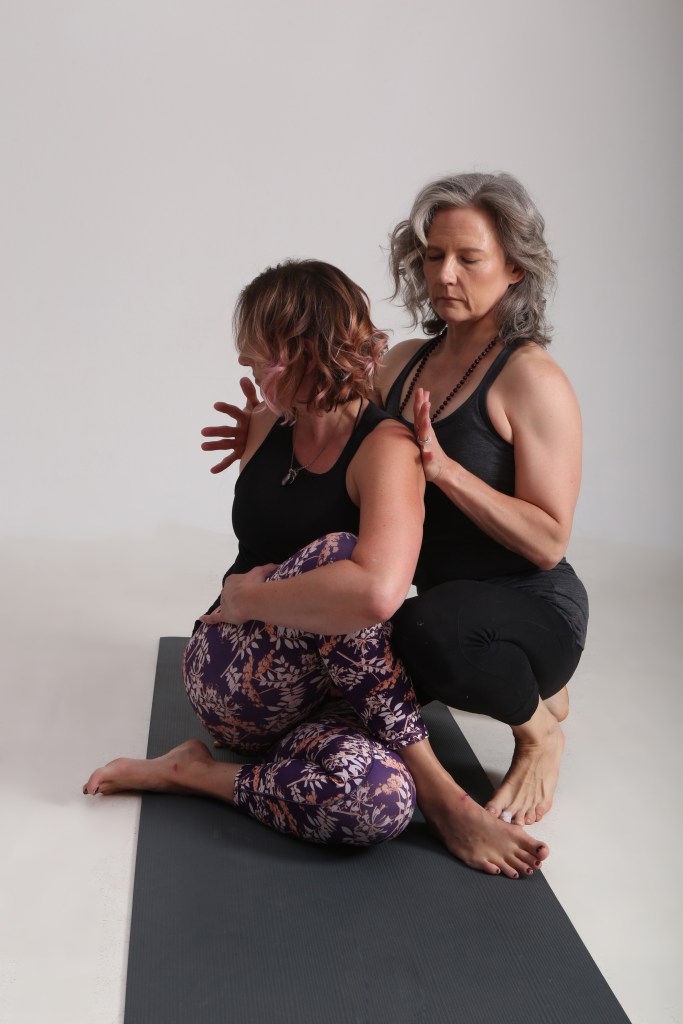
Assist and adjust in the Yoga-asana practice.
Anyone who comes to my class regularly knows that I offer assists and adjustments. I always give students an honest opportunity to opt out, and I try to make it absolutely clear that there is no judgment on not wanting to be touched. There can be a million reasons why someone wants to have their space uninterrupted during practice, and it is not up to me to second guess why that is.
One argument in the camp of ‘non-assisters’ is that students should be able to master and progress within the poses themselves. And some students can do that, and indeed prefer to explore on their own. However; some people do not have a well-developed body awareness when it comes to what body part sits where in relation to each other, and are not intuitively able to find good alignment in their body simply from verbal ques, nor from looking at a pose being demonstrated. This is an observation not only from watching how people move in a yoga class, but something I noticed back in the days when I spend a lot of time ‘down the gym’.
In those cases, if the teacher physically put a student into correct alignment, perhaps with a modification, the student gets the opportunity to experience how a pose ‘should’ feel, the body will gradually start to remember that feeling, which will help the student to progress with the pose by listening to the body rather than relying on the mind to make the connection in the body towards sound alignment. The body and mind connection, is also powerful in restricting a student in a pose. At some point we often ‘stagnate’ at a particular stage in a pose. This can be a perfectly well aligned pose, and perhaps we are happy to stay there. But it can also be the case that our mind has somehow decided this is as far as we can go, whilst in reality there is still plenty of space in the body to go further.
Our mind is very good at holding us back, providing us with reasons and excuses why we cannot do and achieve certain things. So also in our yoga poses. And this is again where an assist or adjust can help. If the teacher safely brings us, physically, beyond what our mind consistently tells us is our limit, our ‘edge’, the body gets a whole new experience. The body realises that it can move past where the mind told us we have to stop. So, the next time we move into a pose and the mind tries to stop us and say, ‘no further’, the body knows better and can ignore the restrictions of the mind. And gradually the mind will also start expanding and allow us realise our full potential!
Can assisting and adjusting be harmful? Most definitely, many a student has been injured by an over- eager teacher, a teacher who just mechanically do something they have been shown at a course, or seen in a book, without considering how every practitioner on the mat is different, without paying attention to signs from the students; reactions in the body telling the teacher they are pushing too far, without taking time to get to know, and to learn to feel, the student’s body and energy. Some students are super strong with dense bodies who can take a strong assist and self-regulate how far it goes. Other students are light, perhaps hyper mobile, and only need the slightest touch and correction.
As teachers we need to learn how to see, feel and know these differences, we are there to support and guide a student’s practice and progression, not to show off what cool assists we can do. It takes time, it takes patience, it takes humility and sensitivity to be good at assisting and adjusting, and doing it safely. And most importantly, the assist and adjust is 100% for the benefit of the student even if that means the teacher has to put those cool moves they just discovered aside, until they meet a student who is ready for it.
 Tiril Yoga
Leave a comment